

Aphrodite & Her Goose

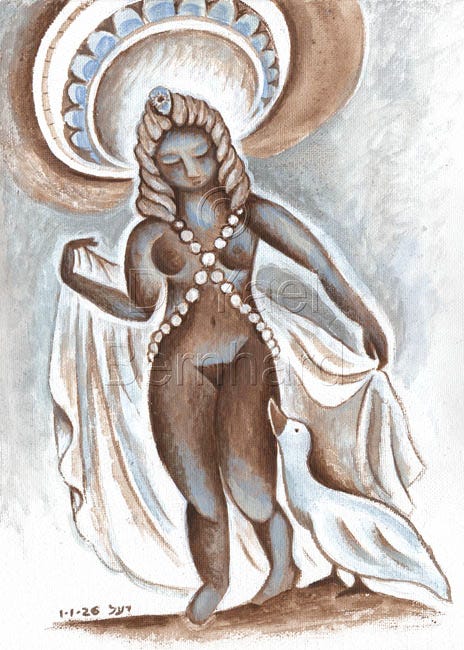
It’s a personal tradition of mine to do a painting on New Year’s Day. I want to begin the year with a day of art, and bring an image to completion before the first sunset. Of course, I must scale down my ambition to fit the activities of the day. Having just a few hours this year, I decided to work on a small study of a sculpture I saw in the Museum of Fine Arts in Boston a few months ago.
It was just a small figurine of Aphrodite in the gallery of ancient Greek art – but she immediately caught my eye, with her subtle, asymmetrical stance, her lovely feminine figure, her pleated drapery and adoring goose.
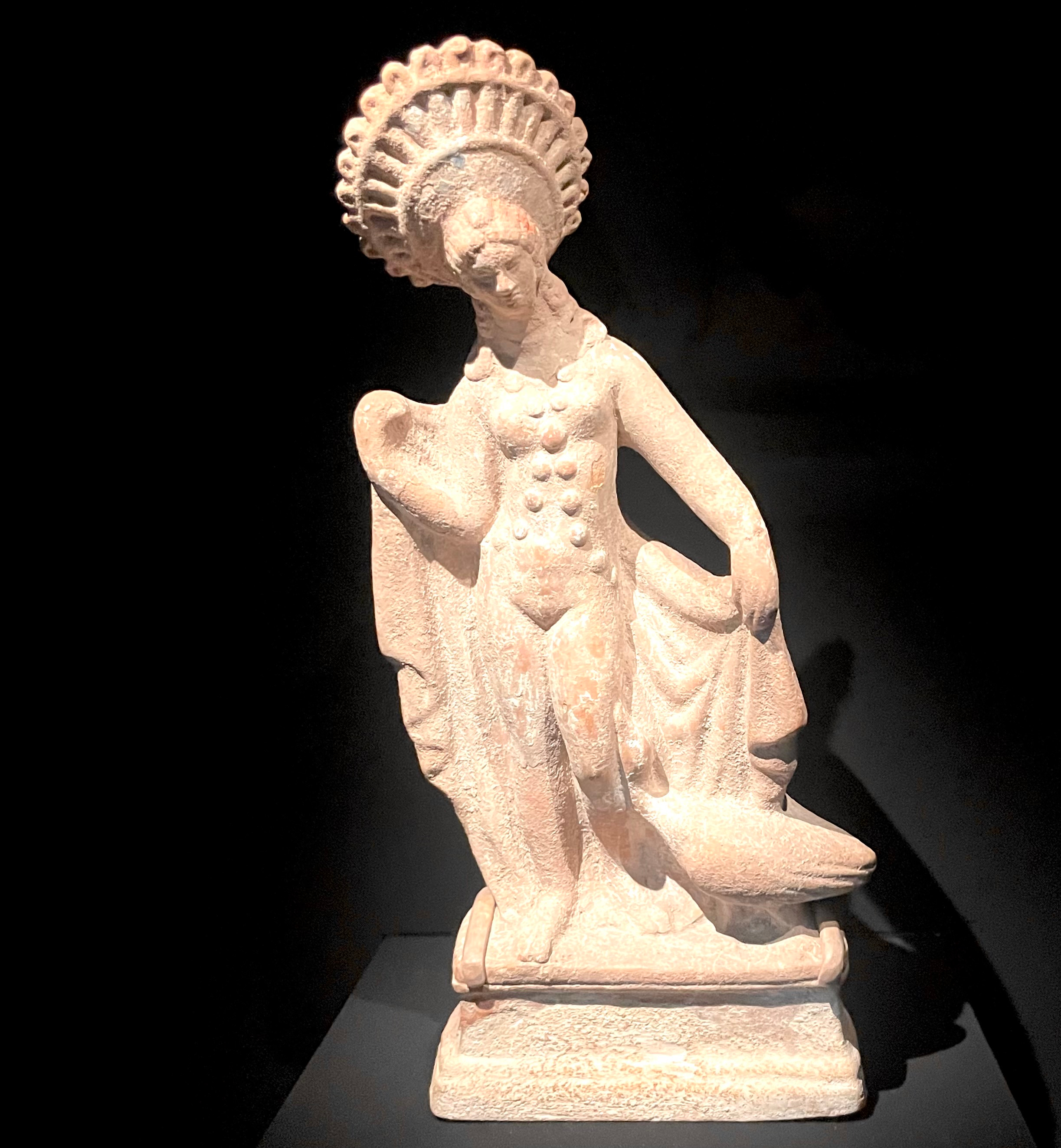
I was so captivated by this little statue, I returned to my photo of it again and again. Some weeks later, her influence showed up in this painting. But I wanted to internalize more of this ancient goddess, with her erotic nature and timeless sense of ease.
Have you ever seen people drawing or painting in a museum? Ever wonder why they do that – try to duplicate another artist’s work? It’s not just for practicing technique. Years ago I did dozens of drawings of African sculptures in the Met Museum in NY, trying to absorb their unique energy. Gazing at a work of art and reproducing its shape and proportions, its colors and textures and sensibilities is a way of absorbing it. This is why I decided to do my own rendering of the little statue of Aphrodite. Maybe if I paint her, I thought, she’ll enter my psyche more deeply.
After some trial and error I settled on a brush drawing – a compromise between a drawing and a painting – in just two colors: blue and brown. I wanted my goddess to be earthy, like a clay figure. I also wanted her to be more than human – thus the blue skin tones, which suggest divinity, as well as water, with which the goddess is also associated. Often Aphrodite is depicted emerging from the sea – and fifteen centuries after this figurine was created, she reemerged in Botticelli’s famous painting The Birth of Venus, where she still holds the same “contrapposto” slanted pose, so typical of Renaissance art. This subtle, asymmetrical pose is emblematic of the emerging humanism that would bring artistic expression down to earth and expand it beyond religious symbolism.
As I translated the ancient figurine into a two-dimensional image, I was amazed by its details, which became more prominent. What an outrageous headdress! And the body beads, criss-crossing between her breasts. The way she casually casts off her garment. And her hairstyle – I have to admit I was a bit befuddled there. Ah well, she’s just a study.
Aphrodite is the ancient Greek goddess of love, beauty, and pleasure. Her goose represents the loyalty and vigilance of a “watch dog,” as well as her ability to fly to other realms, for she is a transcendent goddess. Anyone who has ever been uplifted by eros knows the passion and drive of Aphrodite, who often rides her sacred goose. She is the giver of our most fertile appetites. Her own longings could not be contained, and despite being married to the god of fire and blacksmiths, Hephaestus, she had many lovers, including the god of war. She is the procreative force of nature, ever wild, unpredictable, radiant with life force. I know these energies in myself, and I sense it in others.
I couldn’t help wondering how all this figured in the mind of the Hellenistic sculptor who created this little statue almost two thousand years ago. Certainly he (or she?) paid close attention to her body position, her attire, and the spirit that emanates from her. Aphrodite was a popular subject – the museum’s holdings of just this one goddess are quite impressive. What was the artist’s own desire, in so lovingly carving this figure?
That is for every viewer to decide. As for me, I can’t control how or when any particular influence will manifest in my art – but I’m confident that it will, in good time. I’m walking in the footsteps of the many thousands of artists who have lived before me. What is handed down to me in the stream of time will continue to flow through and beyond me. Art is organic, rising and falling over time just like rivers, mountains, and forests. I just want to be part of the process.
A good week to all!
D. Yael Bernhard
https://dyaelbernhard.com
Have you seen my other Substack, The Art of Health? In addition to being a visual artist, I’m also a certified integrative health & nutrition coach with a lifelong passion for natural food cooking and herbal medicine. Now in its second year, this illustrated newsletter explores cutting-edge concepts of nutrition. I strive to make relevant information clear and accessible, and to anchor essential health concepts in unique images. Check it out, and if you like it, please subscribe and help spread the word. Your support keeps my work going!
The idea of absorbing a work's energy through direct reproduction is something most people never consider. Museums feel like places to observe from a distance, but copying forces you into dialogue with the original artist's hand. That goose as a symbol of transcendence alongside vigilance is such a perfect pairing, like how real devotion requires both groundedness and the willingness to leave solid ground. The contrapposto detail really jumped out once I read about it; funny how we can look at something for ages without seeing its structural genius until someone points it owt.