

Climbing the Cypress Tree

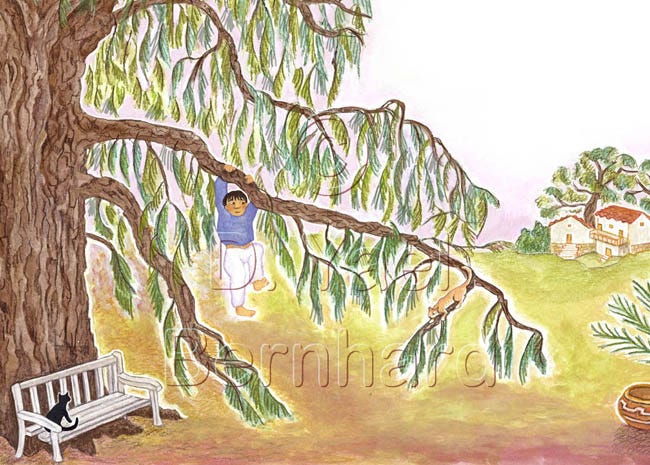
Here’s an illustration from my children’s book Just Like Me, Climbing A Tree: Exploring Trees Around the World (Wisdom Tales Press, 2015). Pictured here is a Montezuma Cypress, a large evergreen that grows along rivers, springs, and marshes in the highlands of Mexico, where it is held sacred by the native people. The famous “Tule Tree” or “El Gigante” of Oaxaca is a cypress, allegedly with the second thickest tree trunk in the world. It is estimated to be over 2000 years old. But outside its native area, these mighty trees become deciduous and drop their needles in winter. Cypress wood is widely cultivated for lumber, as it resists moisture and grows rapidly. The bark and resin may also be used for making medicines.
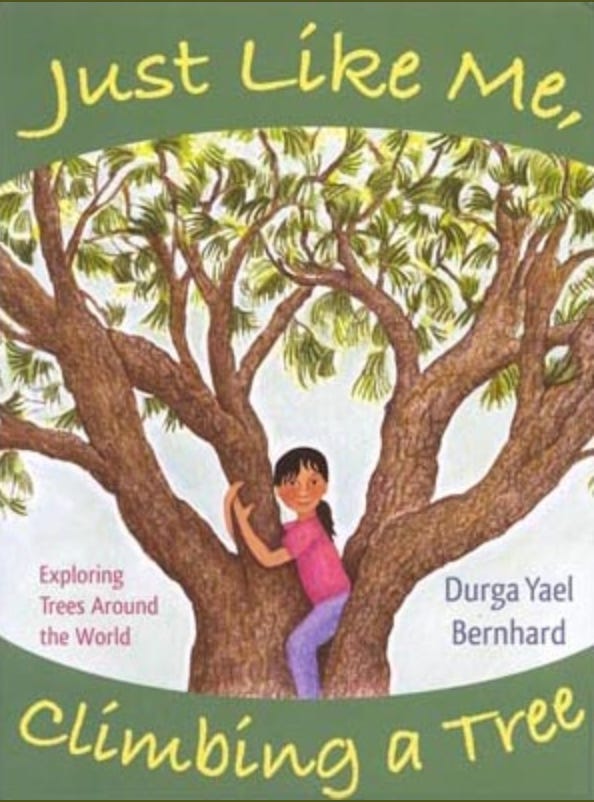
All of this I learned while writing and illustrating this picture book, which features a simple rhyming poem about children interacting with 12 different trees around the world. What all these children have in common, despite their diverse homes and cultures, is curiosity about nature. Like all my multicultural children’s book, the underlying theme is “We’re all the same, in all different ways.”
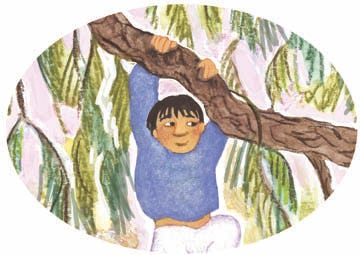
In this illustration, a little boy has shimmied up the trunk and swings like a monkey from the massive, living playground. The two cats are based on my son’s cats, who lived with him at the time when he was in grad school. I like hiding little details from my life and those of my family in my illustrations.
The illustration is done in acrylics, with a touch of colored pencil on top to help articulate the rough texture of bark. The challenge of this book was creating variety from spread to spread, using the structure of each tree to create a unique composition. I also tried to change the colors of each landscape, pushing tints of green toward yellow or blue and changing the color and character of the skies as much as possible.
For older readers, the back of the book contains a long paragraph about each tree with biological and cultural information. It was fascinating learning about kapoks and gingkos, lychees and mangos, olives and baobabs. Choosing which trees, and which cultures, to portray was quite difficult. My editor and I did not want to feature only magnificent trees, but also those which have humbly played an important role in history – such as the white mulberry, pictured in the book in Australia, where English settlers introduced the trees in the 1830s in order to augment the production of silk and latex. Curiously, mulberry leaves come in several different shapes, giving the tree a uniquely irregular appearance.
I’m a lifelong learner, and I love researching the subjects of my books. This is a great educational book for little kids and older readers alike. You can order a signed copy of Just Like Me, Climbing a Tree here.
A good week to all!
D. Yael Bernhard
https://dyaelbernhard.com
Have you seen my other Substack, The Art of Health? In addition to being a visual artist, I’m also a certified integrative health & nutrition coach with a lifelong passion for natural food cooking and herbal medicine. Now in its second year, this illustrated newsletter explores cutting-edge concepts of nutrition. I strive to make relevant information clear and accessible, and to anchor essential health concepts in unique images. Check it out, and if you like it, please subscribe and help spread the word. Your support keeps my work going!