


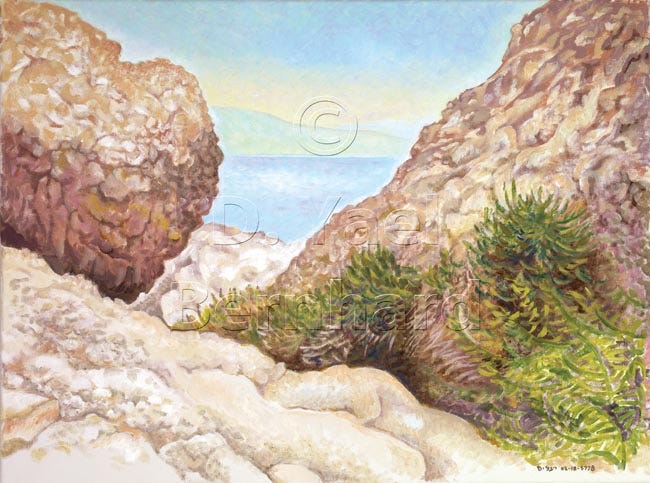
It was around this time of year that I first visited the Dead Sea. My friend and I rented a car in Jerusalem and drove down in the middle of the night in order to beat the heat. As we made our way south in the Judean Desert, the road hugged the bottom of towering mesas that stood like giant sentinels against a clear, starry night. We arrived just as dawn broke, and stepped out of the car into 90-degree heat – the coolest part of the day.
My mind struggled to grasp the passage of time, the thousands of years that had passed since a young shepherd boy named David fled from a wrathful king, finding refuge in the grottos of Ein Gedi. The Judean Desert is incredibly dry, with massive rock formations and not a single tree in sight – yet like a miracle from God, a waterfall shoots out of the walls of this wadi, feeding bullrushes as it tumbles down to the Dead Sea. It was from this perspective, looking down the ravine toward the ancient inland sea, that I saw this view between two rock formations.
Despite the long passage of time, the surface of the rocks is extremely rough. Composed of limestone and dolomite, their craggy, jagged texture is due to two types of erosion: chemical dissolution and mechanical particle detachment. Beyond that, I know almost nothing about geology, but my artist’s eye was attracted to the strangeness of these rocks, which almost seem to speak to each other. Their differing shapes create an interesting negative space between them, through which the shimmering heat hangs over the sparkling salty sea, nearly obscuring the Jordanian hills on the opposite shore.
Capturing the surface texture of the rocks in paint was, as my long-ago college painting professor put it, a matter of “finding order within chaos.” This is true of any subject that has a texture too complex to fully articulate. Rather, one must suggest the multiplicity of leaves that make up the crown of a tree, or the receding faces that form a dense crowd of people, or the thousands of tufts of grain in a field of wheat. The artist must find a way of “mark-making” – that is, suggesting a repeating or random pattern without getting bogged down in details. It requires a loose wrist and a certain ability to relax and relinquish control. Sometimes I think of my paintbrush as the tripping of water over rocks in a stream – moving in short, unexpected strokes, with a light touch. I wanted to convey a feeling of sensuality in the organic shapes of these brotherly rocks, offsetting the clear sky between them. As with almost all my landscapes, there’s an element of tension between opposites – the polarity of rough textures and clear gradients, of near and far, of muted and transparent colors. Rocky ground and spacious air. Ancient and present. Fleeting and eternal.
I began to feel I was painting a portrait – of those two rocks in their home, the House of Time, with its spacious corridors and craggy, silent subjects.
As time passes, the Dead Sea is slowly drying up, but these rocks will be here long after the great salt sea is gone. In this place stripped to its elements, one gets a vivid sense of the passage of time, and the briefness of our individual lives. I had much to ponder as I worked on this painting – months later, from a photograph, as there was no way to bring my art supplies there. Ein Gedi Nature Reserve attracts tourists from all over the world. One hears many languages as people step from rock to rock on the narrow trail, pausing in the shade to get relief from the intense heat.
Most of all I wanted to capture the feeling of this place, so stark and magical. The colors were an exercise in subtlety, which seemed ironic for such an extreme environment. It’s hard to believe any animals can live in that desert, but they do. As my friend and I made our way back to the parking lot, the very mountain goats I’m named after, ya’elot in Hebrew (plural for ya’el, or mountain ibex) were seen making their way down the cliffs. In just a few seconds they disappeared into the strange moon-like landscape that somehow sustains these hoofed and horned antelopes that resemble the pronghorns of the American west. When my ancestors crossed from Moab into the Promised Land, did they see the same thing? Ten steps beyond the parking lot, the landscape seemed unchanged since those times. I could imagine the caravans of camels and donkeys, the people swathed in fabric against the blazing desert sun. The veil between past and present seems rather thin in such a place. Gazing upon this landscape, I felt the boundaries between past, present, and future begin to blur, like the distant, veiled horizon.
A good week to all! – and to all my Jewish readers, Shana Tova U’Metukah – a good and sweet new year.
D. Yael Bernhard
https://dyaelbernhard.com
Have you seen my other Substack, The Art of Health? In addition to being a visual artist, I’m also a certified integrative health & nutrition coach with a lifelong passion for natural food cooking and herbal medicine. Now in its second year, this illustrated newsletter explores cutting-edge concepts of nutrition. I strive to make relevant information clear and accessible, and to anchor essential health concepts in unique images. Check it out, and if you like it, please subscribe and help spread the word. Your support keeps my work going!