


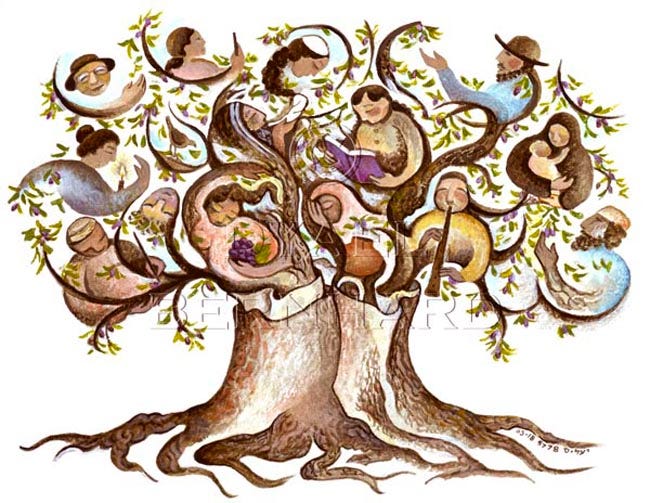
As a theme for art, the Tree of Life is timeless and universal. It appears in numerous mythologies, from the Bible to the Far East, and reappears in modern culture in everything from Christmas trees to animated films such as Avatar. There’s no limit to how the Tree of Life can manifest. To the ancient Maya, the “World Tree” (Yaxche) stood at the center of the universe, with it roots reaching down into the underworld, its trunk in the earthly world, and its branches extending into the heavens. Similarly, the ancient Celts viewed the Tree of Life as a bridge between heaven and earth. In Egyptian mythology, the gods Isis and Osiris were said to have emerged from a mythiccal tree. Known as Etz Chaim in Hebrew, the Tree of Life is one of the many names of the Torah itself, with its deep roots and life-giving fruits – or as King Solomon wrote in Proverbs (3:18): "She is a tree of life to those who grasp her, and whoever holds on to her is happy."
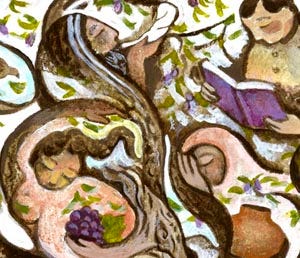
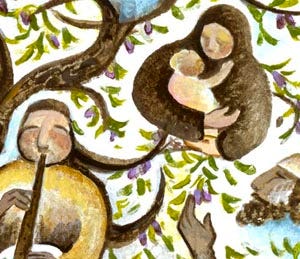
My version of the Tree of Life is a blend of several key concepts. First came my love affair with olive trees, and a desire to depict the Tree of Life as an ancient olive. Next was the desire to populate the tree with people, emerging from its twin trunks and entwined in its curving branches – all kinds of people, doing timeless things that people have always done and still do: playing music, carrying water, holding babies, painting pictures, harvesting fruit, reading and writing, lighting candles, telling jokes. It’s a patchwork of human activity, exemplifying people at their ordinary best. (Okay, I must confess, there is one girl in there looking at a cell phone. Something possessed me to date the painting with this tiny, modern detail. Perhaps it was the influence of my then-teenage daughter.)
The third idea was to make the tree into an organic Torah scroll, which is coiled between and within the two trunks of the tree.
Braiding these three concepts together in one image wasn’t easy. It wasn’t smart, either, as this is generally a prescription for failure. I’ve learned the hard way not to try to cram multiple ideas into one painting, unless they complement each other. For example, I could find a way to show the beauty of mountain wildflowers and the majesty of the mountains in one painting – but if I were to also try to capture the sunset, I’d run into trouble, as the flowers would be muted or even become silhouettes. In this case, to make an olive tree look like a Torah scroll was nearly impossible, not to mention trying to make people look like part of the tree. The whole idea was nuts.
But the image in my head refused to acquiesce, so I stubbornly persisted. I worked in a looser, more imaginary style. The power of suggestion is greater this way, making it easier to fudge reality. I began with a brown “brush drawing” (drawing with a brush in tones of a single color), so that the entire tree could develop all at once as an interweaving of branches, roots, and people. The colors that followed act as accents and counterpoints to “light up” the tree – thus I approached the image more as a colored drawing than a painting.
This is not my first rendering of the Tree of Life, and surely won’t be my last. But this is the most complex one, and perhaps the most human.
This coming week brings Yom Kippur on the Jewish calendar, in which we are symbolically inscribed in the mythical Book of Life for the year to come. Like the Tree of Life, the Book of Life can be imagined in many ways. For me, these ancient spiritual traditions are a never-ending wellspring of inspiration.
A good week to all – and to all my Jewish readers, G’mar chatima tova – may you be inscribed and sealed in the Book of Life for a good year to come.
D. Yael Bernhard
https://dyaelbernhard.com
Have you seen my other Substack, The Art of Health? In addition to being a visual artist, I’m also a certified integrative health & nutrition coach with a lifelong passion for natural food cooking and herbal medicine. Now in its second year, this illustrated newsletter explores cutting-edge concepts of nutrition. I strive to make relevant information clear and accessible, and to anchor essential health concepts in unique images. Check it out, and if you like it, please subscribe and help spread the word. Your support keeps my work going!