

Forest Mother
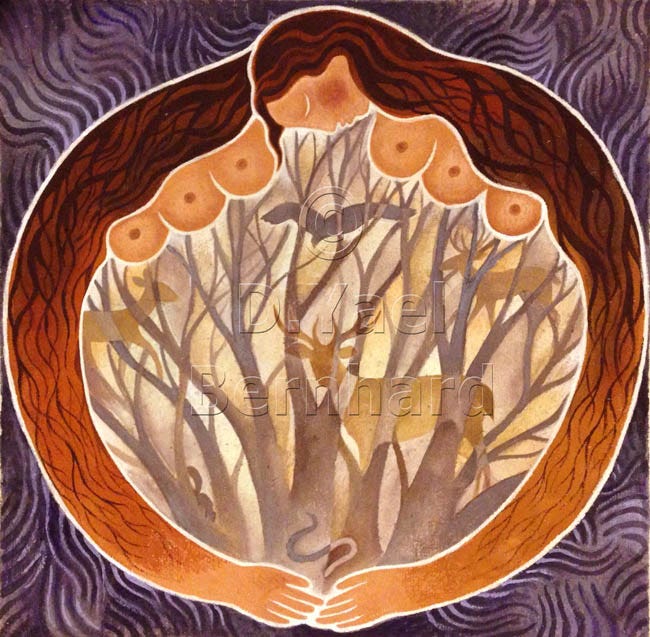
Connection to nature is one of my primary passions and priorities in life, and therefore shows up frequently in my art. Every day I walk my dog two or three times, roaming the fields and forests around my home. I also hike local trails, and forage for mushrooms and wild plants, which are a regular part of my diet. In recent years, as I’ve launched my second career as an integrative health coach and nutrition writer (see my other Substack, The Art of Health), my studies of biochemistry, farming, and the like have further deepened this connection. The more I learn about the human microbiome, the more I realize how closely knitted we are to the ecosystems that sustain us.
But this painting dates back at least twenty years, long before I – or anyone – had even heard of the microbiome. I was an active hunter at the time, and found my connection to the forest through the habits of deer and wild turkeys, which I knew intimately. Whitetail deer are most active at sunrise and sunset, and have a way of appearing out of nowhere in the half light of dusk and dawn. Their eerie silhouettes move silently among the trees, making it necessary for a successful hunter to be extremely patient and acutely aware. Holding still and silent for hours in a tree stand enables one to disappear, undetected by the wildlife around them. This rarefied feeling of blending into the forest was as gratifying as bringing home precious wild meat, and yielded a profound sense of connection to all of nature and life. That’s the feeling I sought to capture in this painting. I am part of a weaving, encircling my prey in the cycle of life and death.
The gradients of transparent color behind the patterns and among the trees were achieved by painting on rice paper. Rice paper is not meant to be painted on – it’s meant for the thick rolled-on ink used in block printing, woodcuts, or other forms of handmade printmaking. It has a blotter-like quality, which absorbs water-based paint like a sponge. In other words, it’s not cooperative with paint – yet I adored the paper’s earthy texture, so I struggled to get the effects I wanted by carefully controlling the amount of bleed. It was around this time that I began to consider trying oil paints – for though I greatly preferred the texture of paper to canvas, I realized paper could no longer fulfill my potential as an artist. Soon after, I obtained my first set of water-based oils, and with a little effort, made friends with canvas.
Lately I’m finding new mysteries in the forest that inspire my art: wild mushrooms, which are incredibly diverse here in the Catskills. Their strange and beautiful forms and colors, and their invisible network of underground mycelium, are perhaps the most impressive manifestation of the web of life. Mushrooms create soil, connect trees, and enable plants to survive on land. Like the deer, they’re an expression of the land that sustains them. Study a deer’s behavior, and you’ve discovered the contour of the land and patterns of wind. Follow a mushroom’s life cycle, and you’ve aligned yourself with the entire ecosystem. It’s endlessly fascinating.
As in life, so in art.
Forest Mother sold a long time ago, but prints and posters are available if you’re interested.
A good week to all –
D. Yael Bernhard
https://dyaelbernhard.com
Have you seen my other Substack, The Art of Health? In addition to being a visual artist, I’m also a certified integrative health & nutrition coach with a lifelong passion for natural food cooking and herbal medicine. Now in its second year, this illustrated newsletter explores cutting-edge concepts of nutrition. I strive to make relevant information clear and accessible, and to anchor essential health concepts in unique images. Check it out, and if you like it, please subscribe and help spread the word. Your support keeps my work going!