

Horned Spirits

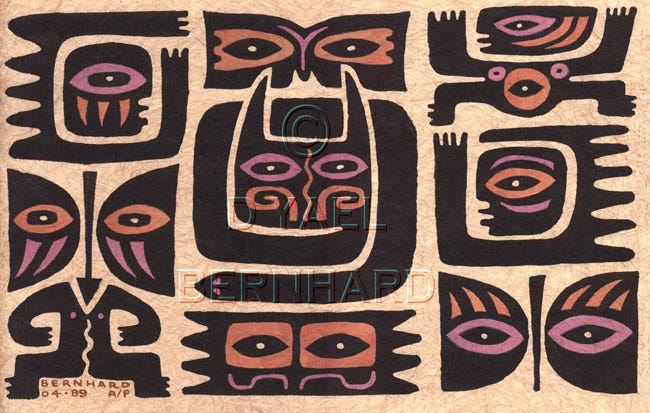
Back in the printmaking phase of my twenties, I was also delving into shamanism. Some seven years into my love affair with African art, I was also exploring other traditions. They were all ancient, earth-centered, with deep roots stretching way back – in most cases, what might be called “primitive” or “tribal”. The indigenous art of Australia, New Zealand, parts of India, Papua New Guinea, Peru, Central America, Ireland, and the Pacific Northwest all carried energies and forms that were both visually and energetically engaging. Something deep and powerful attracted me to these ritual objects, masks, textiles, totem poles, and ornaments. I greedily visited museums, and would stand in front of these objects from faraway lands and try to drink their energy with my eyes. I also devoured books from the library. I felt driven to transmute these works of art into two-dimensional images, and invest them with meanings of my own.
Not just the subject matter but also the architecture of the works I observed influenced me. For example, the above composition is reminiscent of relief sculptures of the Dogon people of Mali, who carved window shutters of dark, ebony wood with figures arranged in a similar “checkboard” manner. My impish creatures are of a similar proportion, with similarly bold and simple features, including large eyes.
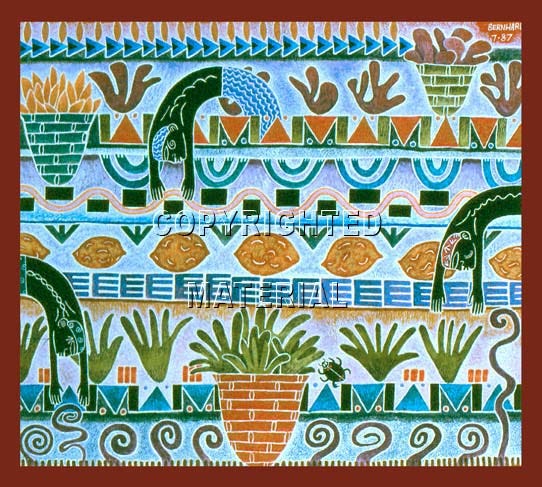
Also from Mali were open-lattice sculptures with rows of animals all carved from a single piece of wood. These led me to pursue a similar composition arranged in rows, in this painting titled Harvest:
But it was the shamanic aspect of so-called “primitive” art that most occupied my mind when I created Horned Spirits. For depicted here are travelers to other realms who have connected with animal spirits and transcended ordinary form. Yes, I was dabbling in psychedelics at the time, and reading books like The Hero With A Thousand Faces and Reindeer Moon. I wanted my transformations to express other states of being. My figures grew horns, crests, tails, and eyes that see the world through animal totems.
Yet a third objective here was to integrate African masks into these imaginary beings. Mask-making is arguably where African art shines the most. Some of the examples I saw in the Rockefeller wing at the Met were incredible. I filled entire sketchbooks there. Photographs weren’t allowed, and though I was known to sneak a pocket camera into museums anyway, film was expensive, and so was the developing. I was a starving young artist, after all. And as mentioned in my post of January 3rd, sketching a work of art is a way to absorb its energy.
Multiple objectives frequently intersected in my art, which often caused problems. One or more of these agendas might contradict the seed idea for the picture. Yet I couldn’t stop these other ideas from asserting themselves. Oh the complex theater of a young imagination! I simply had more inspiration than I could handle.
The only cure for this syndrome is to give each idea its own expression – that is, to do enough art so that each idea comes out one at a time. This is a great pleasure and relief, but doesn’t happen very often, and also usually sprouts other ideas, which also multiply. Doing art gives birth to more art. It’s a nice problem to have. Like most artists, I wish I had more time for my creative work.
Looking back on these jumping and squatting, leering and laughing creatures, I think I did a pretty good job of conveying the seed idea that took hold of my imagination. They are part human, part animal, part geometric shape. The coarsely-woven, flesh-colored rice paper that the linoleum block is printed on shows through, allowing plenty of space around the figures. The hand-colored tints in just two colors interact well with the solid black ink.
Lately I’ve been wanting to get back into printmaking, which I gave up over thirty years ago when my second child was born. Perhaps this will be the year that I dust off my old tabletop cast iron printing press. But I also feel the pressure of the long line of paintings in my head, waiting to manifest. It’s my blessing and my curse, as an artist.
Horned Spirits is for sale. If you’re interested, please respond for more information.
A good week to all!
D. Yael Bernhard
https://dyaelbernhard.com
Have you seen my other Substack, The Art of Health? In addition to being a visual artist, I’m also a certified integrative health & nutrition coach with a lifelong passion for natural food cooking and herbal medicine. Now in its second year, this illustrated newsletter explores cutting-edge concepts of nutrition. I strive to make relevant information clear and accessible, and to anchor essential health concepts in unique images. Check it out, and if you like it, please subscribe and help spread the word. Your support keeps my work going!