

Pruning the Olive Tree

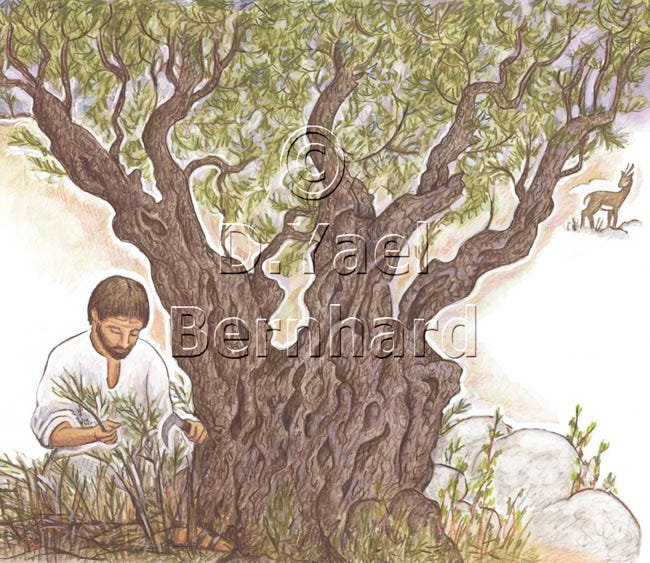
This illustration is from my picture book The Life of an Olive (Heliotrope Books, 2016), which follows the 2000-year lifespan of an olive tree in northern Israel. The story begins in the year 70CE – when the Second Temple in Jerusalem fell under Roman rule, changing the course of history – and ends in 2016, when my humble book was published. Beginning with a historical timeline, the books shows a different century on each spread, and highlights a different aspect of a single olive tree that grows through the story.
This particular scene shows a farmer in the Galilee in the year 370 CE, pruning the olive tree that has been abandoned for over two hundred years. The tree was badly burned in 132 CE during an uprising against the Roman conquest, known as the Bar Kochba Revolt – a major historical event in the region that ended in failure, resulting in the Diaspora – that is, the scattering of the Jewish people to far-flung lands. Yet many did persist in the region, and for two millennia Israel has remained in the hearts of Diaspora Jews as their ancient, cherished homeland.
Like the Jewish people, olive trees have a remarkable ability to survive. As long as their roots are not burned, they can regenerate. But in order for the tree to thrive, the old, damaged wood must be cut away, together with “suckers” – little shoots at the base of the trunk that suck energy and cause the tree to spread out rather than bear fruit. The farmer shown here is patiently cutting away suckers. By the 4th century CE, Christianity had spread over the land, and as this man works, he hears the passing of donkeys in the distance, bearing great beams of wood for the construction of a massive church in nearby Nazareth. That church still stands today.
A mature olive tree is unique individual of organic, woody flesh, folding in on itself and giving each tree a distinctive character. The older the tree, the more shapely and sculpturesque. It was quite challenging to illustrate a single tree as it aged through the story. I traveled to Israel four times to research this book, and photographed hundreds of olive trees, but I never got to see how a single tree evolves from year to year, much less century to century. I had to visually “grow” the main character – a fictitious tree – with the passage of time, making the trunk thicker and branches increasingly gnarly. Really old olive trees – that is, when they are over a thousand years old – tend to split into several trunks, yet as long as they’re pruned, they continue to produce olives.
Researching this book was incredibly gratifying. I spent a week harvesting olives, learned how to prune olive trees, and visited several different kinds of olive presses, both ancient and modern. I learned about the wildlife that lives in and around olive groves, and the people who came from many continents to participate in the harvest. I visited a communal olive press, housed in a Christian monastery, where Palestinian and Jewish growers shook hands and engaged in friendly banter, sharing recipes and techniques for pruning trees and pressing and pickling olives. There is indeed a peaceful atmosphere at olive presses and groves – perhaps owing to the aromatic effects of alpha-pinene, an aromatic terpene found in the leaves, or oleuropein, a unique compound prized for its healing properties. Yet ironically, on the same trip I also sat in an olive grove as rockets and fighter jets seared through the sky overhead, during one of the many wars in which Israel was attacked by her neighbors. Only in Israel does this patchwork of events unfold in such uncanny ways.
Writing and illustrating The Life of an Olive left me with an abiding love of olive trees, and all things olive. There is still so much to learn, for olive trees are interwoven with human history in a mutually-beneficial partnership. Olive oil has played an essential role in the countless kingdoms and civilizations that have risen and fallen in the Middle East and beyond; and olive trees are dependent on humans in order to thrive. Our histories are intertwined.
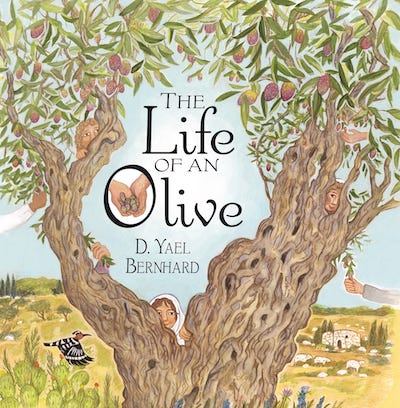
You can order a signed copy of The Life of An Olive from my webstore.
A good week to all!
D. Yael Bernhard
https://dyaelbernhard.com

Have you seen my other Substack, The Art of Health? In addition to being a visual artist, I’m also a certified integrative health & nutrition coach with a lifelong passion for natural food cooking and herbal medicine. Now in its second year, this illustrated newsletter explores cutting-edge concepts of nutrition. I strive to make relevant information clear and accessible, and to anchor essential health concepts in unique images. Check it out, and if you like it, please subscribe and help spread the word. Your support keeps my work going!