


In 2001, I did something special for my birthday. It was my fortieth, and I wanted to start off the new decade on a meaningful note. I was an active hunter at the time, providing wild meat for my two kids and myself. My hunting grounds were 450 acres of an overgrown, rather dilapidated historic estate on the Hudson River, where I rented the old gardener’s cottage. The rolling fields and forests were ideal habitat for wild turkey and whitetail deer. There I spent countless hours roaming the woods at dawn and dusk with my shotgun or compound bow.
Lately I wanted something more. I wanted to taste bear meat, and I wanted to learn how to track bears. I wanted to learn their ways, enter their world, sit in their habitat – which is mostly what hunters do . . . they sit very still, silently observing the seasonal and daily patterns of animals, wind currents, and the contours of the land.
So I signed up for a one-week guided bear hunt in Maine, where black bear hunting season opened late in August. Spending a week of my summer in a wilderness hunting camp sounded like a great vacation, whether I came home with meat or not. Among nine men and two guides, I was the only woman.
The whole week was a memorable experience that engendered many paintings, and an essay of observations and reflections titled The Shared Forest. My two hunting guides modeled good behavior, and an attitude of reverence for nature. A successful hunt, in their view, is one in which you deeply connect to the forest, regardless of the outcome. Returning one day from almost eight hours in my tree stand, I shared what a thrill it had been to hear bear cubs mewing and playing all afternoon. They were close! – and though I couldn’t see them through the dense underbrush, listening to them scraping logs for insects and cavorting was such a privilege, it’s difficult to describe.
My hunting guide understood. “Now you get the true spirit of hunting,” he said. Hour by hour, you become part of the black bear’s world, blending in enough to be the ears and eyes of the forest that is home to these silky, shaggy, shambling yet graceful beasts who could gallop through dense forest without a sound. I once saw a 400lb mature male slip over the rock wall behind my garden like a cat – noiseless and utterly black. On my first night of the hunt, a young bear came in right below my tree stand and nosed around, investigating scents, including my own. Scarcely ten feet away, he stood on his hind legs and batted at a tree branch, pushing it aside like it was a toothpick. It was too dark to shoot, and I sat in motionless rapture, watching. Then like a black fish swimming through the dark thatch of trees, the bear disappeared in one fluid motion. These rarefied moments made the whole trip worthwhile.
In the end I did shoot a bear – in the last hour of light on the last day of the hunt, and brought home 200 pounds of nutrient-dense wild meat, plus the heart, liver, gall bladder, pelt, and claws – precious gifts of wild food, deep nourishment and inspiration. It took years for this experience to trickle down and ripple out through my art. It wasn’t just the bears – it was Maine, the land, the vast forests that sustain the largest population of bears in the U.S. The bears were an expression of the land; I felt that, and after a week of total immersion in this forest, it was difficult to leave. I had begun to knit myself into it, and did not want to let go.
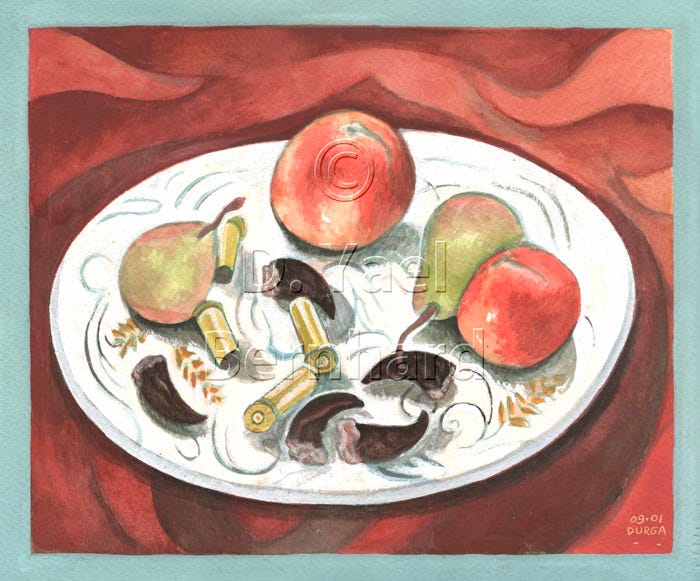
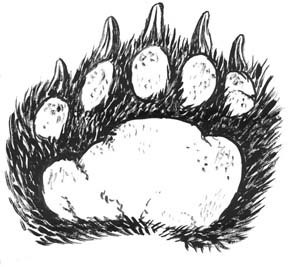
I tried to anchor in writing and art as much of that week as I could. This still life was one such effort; the study of the bear’s paw, below, is another. In this painting, I tried to personify the spirit of the forest itself. Several of the bear’s twenty claws were strung onto necklaces; several were given away as talismans to special friends; two were embedded in the stonework in front of my wood stove, and several more were kept for future use. These I dropped on a plate together with two plums, two small homegrown pears, and the shells of the copper sabot slugs I used in my 20-gauge rifled shotgun.
It made a good arrangement, and a focal point of reflection for several hours while I worked on the painting. A still life is not just an image – it’s an object of prolonged contemplation caught in an image. There’s something calming and settling about it, as the subject is not restless like a human model, unpredictable like an animal, or ever-changing like the light on a landscape. The artist can patiently strive to both convey reality and transform it into their own creation. The portrayal of the bear claws and shotgun shells as ordinary objects speaks to the cycle of life and death – the same ordinary but profound cycle that governs the ripening and decay of fruit, as well as the growth and aging of both the artist and the viewer. The plate itself could represent this cycle, holding everything within its circle and surrounded by a blood-red tablecloth.
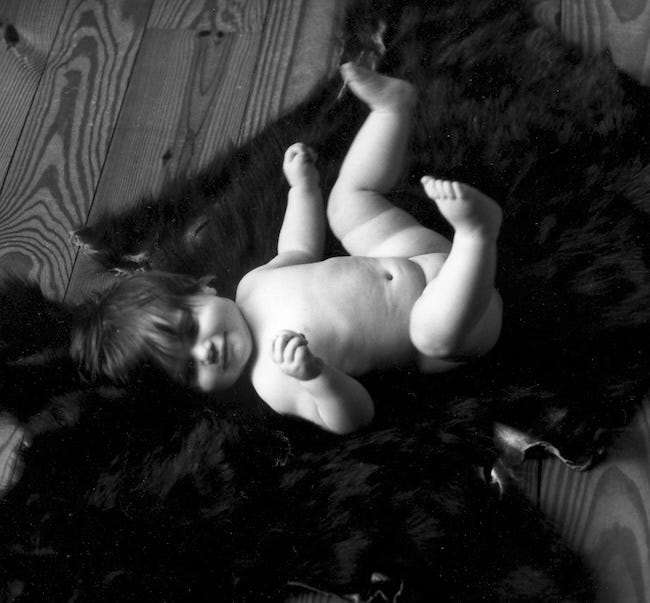
Art can be a ritual that memorializes the experiences that shape our lives, and expresses the meaning we make of them. For me it was a way of anchoring my connection to those bears and the land they live on. Of course, eating the meat I brought home was another way to internalize the experience, which I did throughout the following year. As chance would have it, a few weeks after my trip to Maine, I became pregnant with my third child. I ate the entire bear during my pregnancy, satisfying cravings that were truly a force of nature. Sage Ursa Bernhard was born the following June with thick, black hair. She’s no pushover, this girl, let me tell you.
A good week to all!
D. Yael Bernhard
https://dyaelbernhard.com
Have you seen my other Substack, The Art of Health? In addition to being a visual artist, I’m also a certified integrative health & nutrition coach with a lifelong passion for natural food cooking and herbal medicine. Now in its second year, this illustrated newsletter explores cutting-edge concepts of nutrition. I strive to make relevant information clear and accessible, and to anchor essential health concepts in unique images. Check it out, and if you like it, please subscribe and help spread the word. Your support keeps my work going!