

Study of Olive Tree
I can’t remember exactly when I fell in love with olive trees. If you’ve been smitten, you understand what it is about these remarkable living creatures, each with their own personality. Olive trees are individuals. They grow and evolve over decades, centuries, even millennia. Over this long lifespan, they’re shaped by experience and form a unique character that grows outward and folds inward, like an organic sculpture. Both enduring and changing, olive trees are markers of human history, having born witness since ancient times to rituals of sacrifice, the anointing of kings, the rise and fall of empires, and the passing of countless generations. Yet these trees are humble and silent, patiently enduring drought and hardship, and providing refuge for wildlife and wanderers. In their presence is a peaceful fragrance; in their leaves is powerful medicine; and the oil of their fruit has served humanity since the dawn of civilization.
It’s a two-way partnership, for olive trees are dependent on humans in order to thrive. Without proper pruning, they do not produce fruit and do not live as long. Thus, olives and humans have been mutually interdependent over the centuries. It has been postulated that a well-pruned olive tree may continue to generate new growth from its roots in perpetuity. Thus, they are a manifestation of resurrection, for even if you chop and olive tree down, as long as the roots are not burned, it will regenerate. It is no coincidence that Jesus spent his last night praying in an olive grove – the Garden of Gethsemane (which is a mix of Aramaic and Hebrew for “oil press”), which I also visited as part of my research.
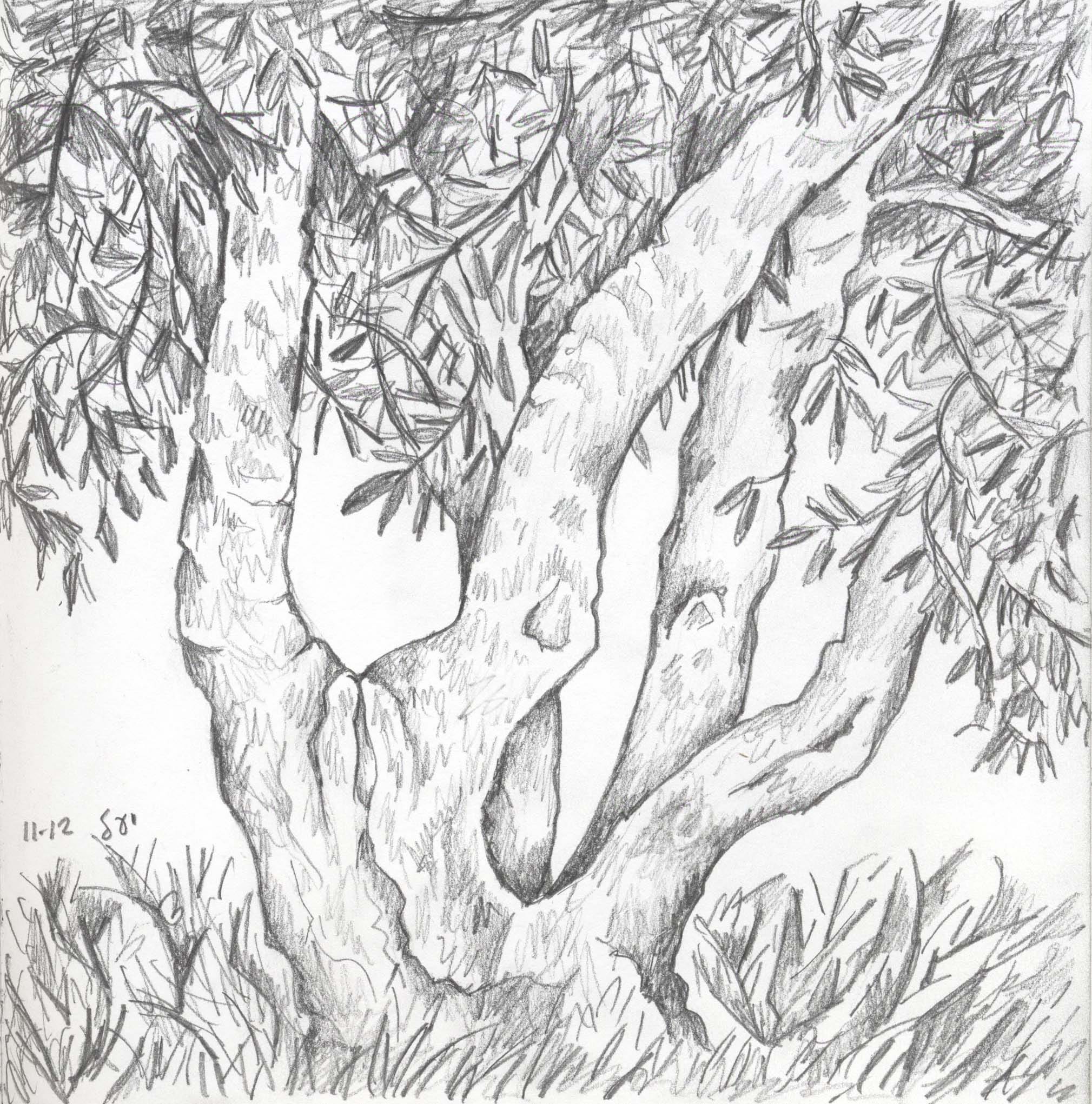
As a subject for art, olive trees are inexhaustible. I never tire of them. The leaves are simple and slender; the pale-spotted fruits (known as “drupes”) change in color as they ripen, from milky green to mauve to purplish-black. The branches and trunk are shapely and curvaceous, all of a certain pattern and proportion that can only be portrayed with practice. And practice I did, in order to illustrate an entire book about an olive tree that lives from ancient to present times. This drawing is one such study, done at Kibbutz Gezer in central Israel. There I spent a week harvesting olives as part of my hands-on research for The Life of An Olive (see below).
It’s said that most painters are either primarily a colorist or a shapist. I must be both, but here is a subject that truly celebrates shape and form. Rendering this portrait in pencil was so satisfying. The tree shown above was a mere fifty or sixty years old – a youngster in the lifespan of an olive.
Older olive trees – say, five hundred years old or older – begin to split and fold in on themselves to such a degree that the original trunk may become hollow, or divide into separate pillars. They’re still connected in their roots, but begin to look like two bark-covered beings standing side by side. Seeing such old trees is truly awe-inspiring. These ancient trees may be seen here.
Being an illustrator has led me to explore incredibly diverse subjects. This was one of the richest paths my work led me down. Though the fictitious tree in my book serves as a yardstick of human history, the story is about the tree and the people who interact with it, century by century.
There’s so much to learn about olives and olive trees!
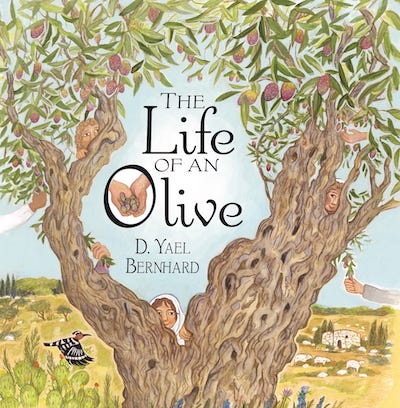
You can order a signed copy of The Life of An Olive here.
A good week to all!
D. Yael Bernhard
https://dyaelbernhard.com

Have you seen my other Substack, The Art of Health? In addition to being a visual artist, I’m also a certified integrative health & nutrition coach with a lifelong passion for natural food cooking and herbal medicine. Now in its second year, this illustrated newsletter explores cutting-edge concepts of nutrition. I strive to make relevant information clear and accessible, and to anchor essential health concepts in unique images. Check it out, and if you like it, please subscribe and help spread the word. Your support keeps my work going!