


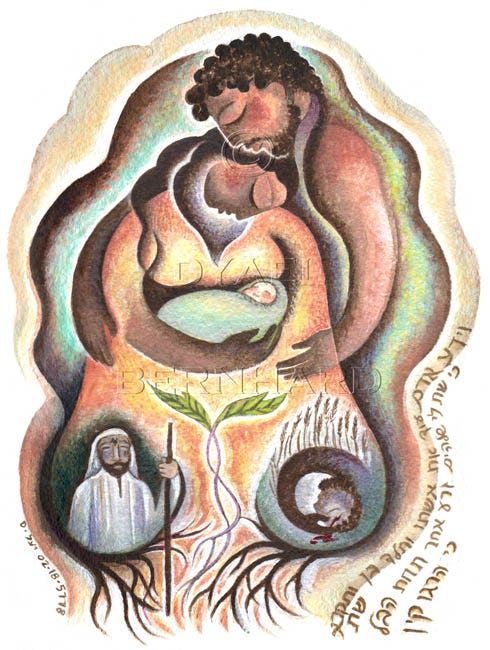
In the Book of Genesis, Seth is the third child of Adam and Eve. This is no ordinary child, as his birth follows the loss of their first two sons – Abel, who is slain by his brother; and Cain, who is cursed by God and sent into exile for murdering his brother. The passage, recited today as part of the weekly Torah portion in synagogues all over the world, reads as follows:
“And Adam knew his wife again, and she bore a son, and she named him Seth, for God has given me other seed, instead of Abel, for Cain slew him.” – Genesis 4:25
This is just the bones of the story – but one can imagine, in the wake of such grief, that this third child arrived as a beacon of hope and healing. The third child is also emblematic of a deeper resolution – one which is found in folklore the world over. It even has a name: tertium quid, the “third something” that resolves a dualistic conflict. In Kabbalistic literature, this "third thing" is that which mediates between opposite poles.
“When a narrative presents a binary opposition that cannot be reconciled within its own logic (such as Light vs. Dark, Order vs. Chaos, or Spirit vs. Matter), the ‘third thing’ emerges not as a simple compromise, but as a transcendent force that fundamentally alters the nature of the problem itself.” – Academia.edu
What is the binary opposition represented by Abel and Cain? Some theories draw upon the etymology of their names, which points to Spirit vs. Matter; others focus on their character attributes. Abel brings an offering of “the firstborn of his flocks” to his Creator, while Cain offers “the fruit of the soil.” Is this a conflict, then, between meat-eaters and vegans? Between shepherds and farmers? Nomads and settlers? Or between pure innocence and evil, as one brother turns against the other, unable to overcome the sin that crouches within?
The arrival of Seth marks the end of this violent polarity. Throughout the Book of Genesis, sibling rivalries do continue, but never again is it murderous (though nearly so). By the time the Book of Exodus begins, we finally see two brothers – Moses and Aaron – cooperating and working together. And the Creator continues to accept offerings of both animals and plants (as well as incense, wine, oil, grain meal, and flour) – suggesting an omnivorous diet, in keeping with our biological blueprint.
Seth is scarcely mentioned again in the Bible, though he lives to the age of 912, and through a long lineage is the progenitor of Abraham, Ishmael, Isaac, Jacob, and ultimately, Jesus (through Isaac) and Mohammed (through Ishmael). We are descendents not of Cain, not of a wrathful and jealous brother – but of Seth, the third child, the child of consolation and healing.
Just knowing that is consoling, somehow.
In Hebrew, the name Seth is pronounced Shayt, and means “appointed,” “placed,” or “set.” The ancient sages interpreted this to mean that Seth is the spiritual and physical foundation of all humanity, set in place before the Great Flood, and enduring for all time.
All of this was most intriguing to me, and still is. As chance would have it, not long after I first read the story of Seth, I was commissioned to paint an image for a mother who had lost a newborn daughter, and after a year of agonizing grief, joyfully gave birth to a second baby girl. What better consolation in the wake of untimely death than a new life? My heart went out to this young mother, and to her mother, who commissioned the painting for her bereaved daughter. That our civilization’s foundational family begins with such a loss speaks to its universally human nature. Humanity got off to a rocky start.
Fortunately we’re all works in progress, both individually and collectively. It seems we must all deal with intractable conflicts – jealousies, rivalries, destructive impulses, tragic losses – and then wait for the tertium quid that follows. All three brothers are shown in this painting, curled within the destiny of their parents. I painted them first in an earthy, monochromatic foundation of dark brown, which I then overlaid with color. The few verses of the story are drawn in a mix of Hebrew print and script, which I was learning at the time. It’s a beautiful language.
The Birth of Seth is for sale. Please inquire for more information if you’re’ interested.
A good week to all!
D. Yael Bernhard
https://dyaelbernhard.com
Have you seen my other Substack, The Art of Health? In addition to being a visual artist, I’m also a certified integrative health & nutrition coach with a lifelong passion for natural food cooking and herbal medicine. Now in its second year, this illustrated newsletter explores cutting-edge concepts of nutrition. I strive to make relevant information clear and accessible, and to anchor essential health concepts in unique images. Check it out, and if you like it, please subscribe and help spread the word. Your support keeps my work going!