

The Empty Vessel

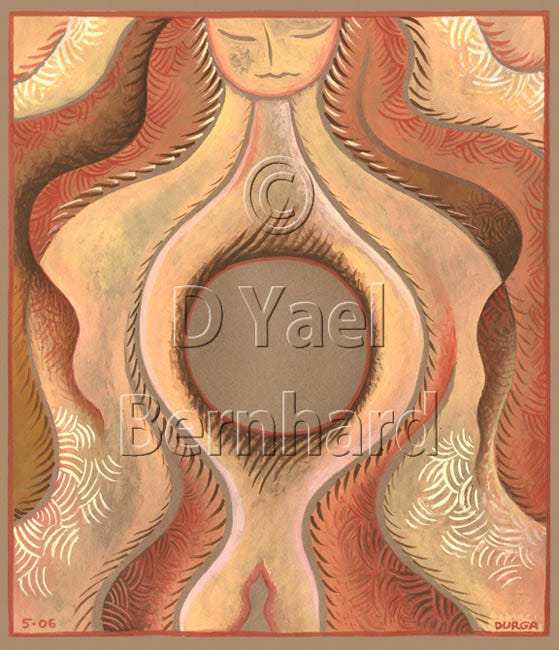
What do you do with a blank canvas, or an empty sheet of paper? When my art students claim they lack ideas, I often suggest they simply make a design out of a face. It’s a basic starting point that can lead in endless directions. The design can be part of the face – or as in this case, the face can be part of the design.
The paper, too, is part of this design, as I specifically wanted it to show through. That earthy, neutral color in the center of the painting (and showing through elsewhere) is bare paper – a thick, toothy paper meant for drawing with pastels, but sturdy enough to take gouache paint without buckling. I had purchased an individual sheet, determined to create some kind of open-lattice design that would allow this color to show through.
This was no small challenge. I have a tendency to over-activate space, to engage every area of a composition with visual subject matter, and to cover the entire surface of a painting. I wanted to do something different here. Starting with the neutral mid-tone of the paper, I used lighter and darker tones of paint to interact with it.
The image itself emerged from the transition in my life then taking place, back in the early 2000s: that of a mother of whose childbearing years were coming to an end. It was around the time my youngest child weaned. My three babies were fairly spread out, and I had been caring for little ones for almost twenty years. Grateful for my children but also sad that there would be no more, I felt a certain emptiness within, like I was an empty vessel. What would fill this space as this period of my life came to a close? Who would I become as my children grew up and flew the nest?
The painting is a question, not an answer. My musings as a mother simply intersected with that sheet of colored paper, and out came this image. Once again, content merged with technique, and produced a unique offspring. The restricted palette was a pleasure as I explored all possible relationships between two colors that are lighter than the paper, two that are darker, and one that is nearly identical in tone (the rosy flesh-colored hue). Printmaking had taught me to think in terms of limited colors, and the use of contrasting tones to create graphic effects. It was a great discipline.
I love imposing these “liberating restrictions” on my art. It always seems to produce interesting effects. I saw many of the Post-Impressionist artists I admired working within deliberate restrictions as well – such as the limited palette of Picasso’s “blue period,” or the strange geometries that restricted the paintings of Paul Klee to structures that seem to follow esoteric laws (see example here). I, too, think in terms of “visual physics,” and often strive to build a framework to express an idea or a theme. The architecture is the bones of the image; the content or theme is the flesh that hangs on those bones, and brings them to life.
The Empty Vessel is nothing more than an architecture of wavy, organic lines organized around an empty circle and forming the suggestion of a figure. These lines create overlapping rivers of color that are accentuated by textures. The face is hardly there at all . . . that’s part of the point: she’s disappearing.
This painting is for sale . . . that is, if I can find it among my stacks of works on paper. Please inquire for more information if you’re interested.
A good week to all!
D. Yael Bernhard
https://dyaelbernhard.com
Have you seen my other Substack, The Art of Health? In addition to being a visual artist, I’m also a certified integrative health & nutrition coach with a lifelong passion for natural food cooking and herbal medicine. Now in its second year, this illustrated newsletter explores cutting-edge concepts of nutrition. I strive to make relevant information clear and accessible, and to anchor essential health concepts in unique images. Check it out, and if you like it, please subscribe and help spread the word. Your support keeps my work going!
What a mystery that empty space is in the center - a portal - it looks like to infinity . . . perhaps infinite possibility is the gift that emptiness offers.