

The Slave Brothers

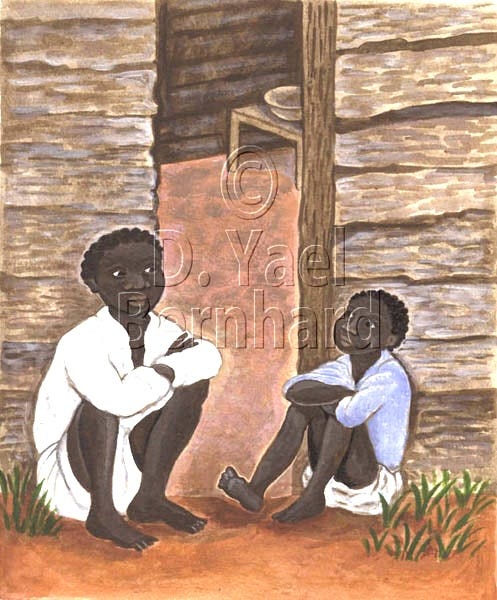
This illustration was one of a series done for a “leveled reader” produced by an educational publisher. These are short booklets, sometimes bound into textbooks, that teach vocabulary to elementary school students. The stories are rather simple (some would say “dumbed down”), and serve not only to introduce new words, but also touch upon cultural or historical subjects – in this case, American slavery.
It wasn’t the first time I received such an assignment. The influence of African culture, Eastern religion, and world music on my art earned me a reputation as a multicultural illustrator. I had already published several multicultural picture books that took readers around the world. And I daresay I was better at painting black children than white ones, despite my own children’s fair skin.
Presenting a subject like slavery to children is tricky, to say the least. It requires striking a balance between telling the difficult truth and traumatizing kids who are too young to understand it. Slavery is a black stain on American history, yet it is integral to the foundation and formation of this nation. I understood my editors’ desire to spare young readers the unspeakable brutality of the slave trade – but at the same time, I felt they had whitewashed the truth a little too much, making it seem like the slaves in this story were more like happy farm servants. At the same time, I appreciated their efforts to make the activities and aspirations of the main character – the younger lad shown here – those of any normal boy. My illustrations show him playing hide & seek with the other slave children; falling asleep in the hay wagon; showing up late for supper; staying out after dark and being reprimanded by his mother; watching her darn socks by candlelight, and listening to her hum a tune. These behaviors affirm the sameness of children everywhere, and that’s a good thing.
I also liked the caring attributes of the boy’s family. In this “illo,” he’s shown talking to his older brother, who has seen the world beyond the plantation. The younger boy has a sense of adventure, and hungers for better horizons. His brother encourages him, and tells him about several trades me might learn someday, when he’s older. Was such a prospect even remotely possible for a slave boy on a cotton plantation?
It was gratifying to create an image of a kind and supportive sibling – something I’ve never experienced and always wished for. The message is clear: even extreme hardship may be transcended by loving family relationships. And even within the constraints of slavery, a young boy has the freedom to dream. I couldn’t argue with this, and it would have been futile to try – even my editors’ hands were tied by their corporate superiors, who dictated how the book must turn out: tidy, accessible, and uncontroversial. As the content creators of this story, we were like slaves to our masters.
So I did my best to endow these two boys with universally human characteristics, so that contemporary children might imagine themselves in their shoes – or rather, their shoelessness. I enjoyed painting the rustic texture and earthy colors of the little rough-hewn cabin, and left it to my readers to imagine what it would be like to live there. Soon enough, they will grow up and learn the bitter truth of human subjugation and cruelty. But not yet – not just yet. I didn’t want to spoil my readers’ dreams any more than those of this sweet little black boy.
A good week to all –
D. Yael Bernhard
https://dyaelbernhard.com
Have you seen my other Substack, The Art of Health? In addition to being a visual artist, I’m also a certified integrative health & nutrition coach with a lifelong passion for natural food cooking and herbal medicine. Now in its second year, this illustrated newsletter explores cutting-edge concepts of nutrition. I strive to make relevant information clear and accessible, and to anchor essential health concepts in unique images. Check it out, and if you like it, please subscribe and help spread the word. Your support keeps my work going!