

Window Through the Window

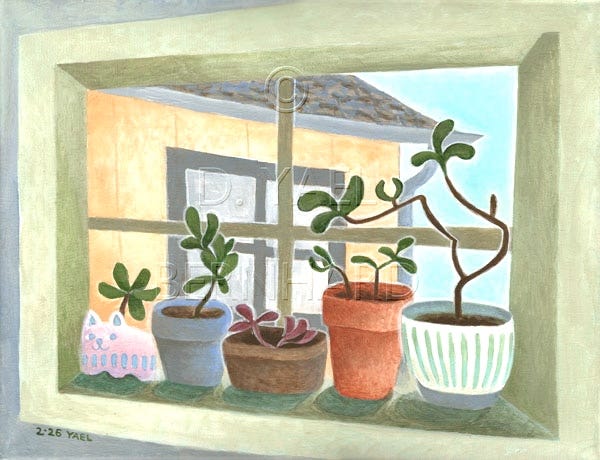
Two weeks ago I visited my son in North Carolina. In the room where I slept, several little plants were perched on this windowsill, out of reach of a sweet old cat who has a penchant for chewing on houseplants. Some of these poor potted fellows were struggling to recover from the latest feline assault, but they were alive, and the five of them together made a nice little quintet.
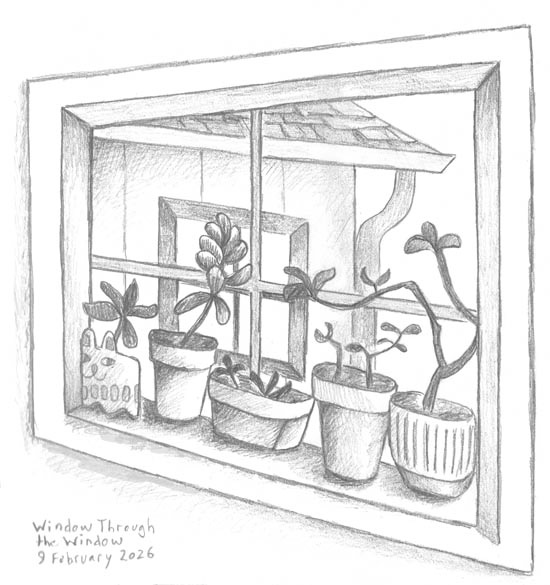
More interesting, however, was the view of the window through the window. Several weeks ago, I wrote about my attraction to windows and doors as a subject for art. These two windows, with their varied angles, were the first thing I saw upon opening my eyes in the morning. The juxtaposition of the organic shapes of the plants, twisted and scraggly as they were, with the angular lines of the windows, was most intriguing. The interacting diagonals were even better. I knew if I flattened them onto one plane, they would be slightly discordant, as the window outside would not be visible unless I looked at it from an angle – but could I pull them into harmony with each other?
I started with this pencil drawing in my sketchbook, which is all I had with me:
I knew this was destined to become a painting, but after some consideration, I decided not to take a photograph of the scene. I did not want any color reference – rather, I decided to be faithful to the composition, but to bring in an imaginary palette. My son loves blue and green, and has debated painting this room a pale mint or aqua. So I painted it for him, and changed the colors of the plants and the house outside, too – but not by much. The painting changes reality, but does not depart from it. That’s generally my goal in painting scenes from life – not to create abstractions, but to interpret and reinterpret my subject. Although many artists strive to either depict or abandon reality, my desire is to transform it.
Doing a painting only from a previous study, whether a black & white drawing or a color sketch, is one way to accomplish this. Because the final painting is an interpretation (and usually an enlargement) of an interpretation, this forces the image to change from one iteration to the next.
It’s hard to let go of reality and yet remain faithful to a subject, conveying its structure and harmony, its character and meaning. The Post-Impressionists were masters at this. Just look at any still-life by Cézanne, Matisse, or Van Gogh, who transformed ordinary objects into something magical. They never cease to amaze me.
A good week to all!
D. Yael Bernhard
https://dyaelbernhard.com
Have you seen my other Substack, The Art of Health? In addition to being a visual artist, I’m also a certified integrative health & nutrition coach with a lifelong passion for natural food cooking and herbal medicine. Now in its second year, this illustrated newsletter explores cutting-edge concepts of nutrition. I strive to make relevant information clear and accessible, and to anchor essential health concepts in unique images. Check it out, and if you like it, please subscribe and help spread the word. Your support keeps my work going!