

Woodland Menorah

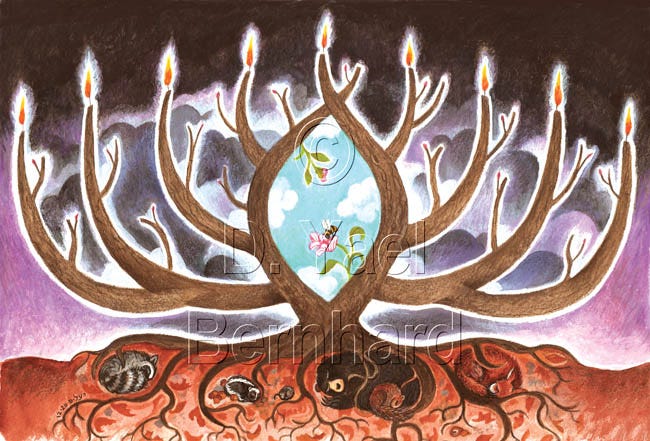
This illustration from The Jewish Eye Calendar of Art is one of two paintings I did of the same subject: the menorah as a tree of life, sleeping through the winter with hibernating animals in its roots. The other version, “Winter Menorah,” may be viewed here.
Jewish tradition is old and vast, spreading across the world in a diaspora that began with the destruction of the Second Temple in Jerusalem in the year 70CE. Since then, the Jewish people have settled on every continent except Antarctica, assimilating into local cultures and climates. Here in the Northeast, Chanukah is a winter event. And though the original menorah was fashioned as an almond tree hammered of pure gold, the holiday allows for endless varieties of expression. The Jewish Museum in New York City has a dazzling collection of innovative menorahs, with candleholders fashioned as everything from the Statue of Liberty to jazz musicians. I love this endlessly creative aspect of Jewish tradition, which is also an expression of cultural diversity.
A painted menorah has the great advantage of not needing to be fireproof or practical in any way. Thus I was able to indulge my idea of the tree of life, sheltering the animals curled up under the earth and also containing at its center the promise of spring. I couldn’t decide whether to make it a snow scene or not, which was my original idea – but dark winter skies and earthy colors also persisted in my imagination. In cases like this I often do two versions, which is doubly rich.
Chanukah begins at sundown tomorrow night, and this year, ends on Winter Solstice. The holiday commemorates freedom from the oppressive rule of the Seleucid Greek empire in ancient Israel, in the 2nd century BCE. It’s not directly tied to the seasons (except that it’s associated with the olive harvest and the pressing of new olive oil). But in the sense of turning from oppression to freedom and therefore from darkness to light, I also see a connection to Solstice. Nature isn’t a power-hungry tyrant like the ancient King Antiochus was, but winter can be very harsh, and is indeed a challenging time. Here in the Diaspora, deciduous trees are symbols of renewal, as they go through a sort of death and rebirth each year. The animals sleep patiently under the earth, awaiting the promise held out by the tree that new life and abundance will return in the spring.
One thing I love about winter is the muted colors, which I thoroughly enjoyed in this painting. It took quite a bit of trial and error to get the shape of the tree right. The aperture in the center was the solution, and provided a window into the future. It would be interesting to paint this tree in its opposite state, too: in high summer, fully leafed out, with winter at its center. Maybe a third version is taking shape . . .
The Jewish Eye Calendar of Art sold out this year, and is no longer available except from The Tender Land gift shop in Phoenicia, NY; and at the Woodstock Jewish Congregation. You can view all the images here.
To all my Jewish readers, Chag Chanukah Sameach – Happy Hanukkah! May the festival of lights bring joy and renewal to you and your loved ones.
A good week to all –
D. Yael Bernhard
https://dyaelbernhard.com
Have you seen my other Substack, The Art of Health? In addition to being a visual artist, I’m also a certified integrative health & nutrition coach with a lifelong passion for natural food cooking and herbal medicine. Now in its second year, this illustrated newsletter explores cutting-edge concepts of nutrition. I strive to make relevant information clear and accessible, and to anchor essential health concepts in unique images. Check it out, and if you like it, please subscribe and help spread the word. Your support keeps my work going!